Let me be blunt.
Most founders don’t have a sales problem.
They have a go-to-market (GTM) execution problem.
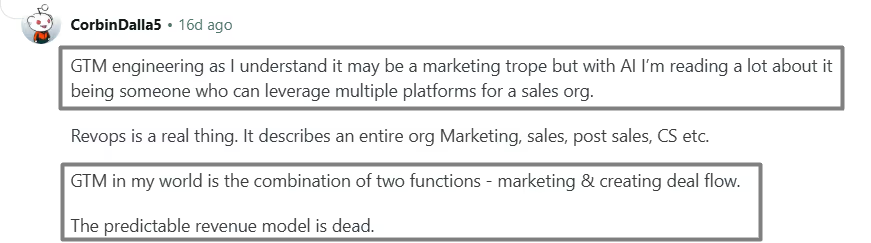
GTM engineering emerged as a response to the complexity of modern go-to-market systems, requiring scalable processes, automation, and seamless integration across a growing number of SaaS tools.
Leads are leaking.
Reps are guessing.
Tools aren’t talking to each other.
You’re spending 10 hours/week duct-taping workflows, when that should be a system
This is exactly where a GTM Engineer comes in. GTM engineers wear multiple hats and play a key role in supporting the company's GTM strategy by integrating systems, automating workflows, and building scalable processes.
Go to market engineering is about building revenue engines using AI and automation to optimize GTM strategies and drive operational efficiency.
Not another “RevOps hire.”
Not just a CRM admin.
A builder. A system thinker. A full-stack revenue operator.
In this blog, I’ll break down:
Whether you’re a startup founder, agency owner, or sales leader tired of broken outbound…
This is the guide you’ve been looking for.
If you’ve been searching:
…then read every word.
It’ll save you 6 months of painful trial and error, and thousands in wasted spend.
A GTM Engineer is not just a fancy title for RevOps.
This is a completely different beast.
A GTM (Go-To-Market) Engineer is the person who builds the systems, automations, and integrations that connect your marketing, sales, and customer success into one seamless revenue engine.
Their core responsibilities include integrating tools, supporting growth operations, and ensuring technical processes align with business goals. The GTM engineer role is a versatile position essential in startups, akin to a growth hacker, and acts as a technical specialist focused on translating technology into revenue-generating solutions.
They don’t just track pipeline, they architect it.
GTM engineers bridge the gap between product, sales, and marketing teams, requiring both technical skills and technical fluency to communicate complex concepts across departments.
GTM Engineers are expected to have a blend of technical skills—such as coding in SQL or Python—and commercial awareness to effectively support rapid company growth and adaptability.
In simple terms, A GTM Engineer is the technical operator behind your revenue growth. Think of them as a hybrid of product-minded ops, API-savvy builder, and revenue strategist, all in one.
It’s important to note that sales engineering is a distinct, highly customer-facing role focused on technical sales support and solution design.
Sales engineering does not overlap with GTM engineering or RevOps responsibilities, as it is primarily engaged in direct customer interactions and technical presentations.
If you’re trying to build a repeatable go-to-market motion, you can’t rely on VLOOKUPs and Slack threads.
You need someone who can:
GTM engineers fill gaps in broken systems and manual processes by building and automating GTM workflows. They ensure that data flows cleanly across systems to support revenue generation.
In short, they don’t just maintain CRMs, they create pipelines.
Here’s exactly what GTM Enginners do (and how most teams get it wrong):
If you’re pulling leads from LinkedIn or tools like Leadsforge, someone needs to clean that data, enrich it, check if the emails are valid, and send it to the right rep or sequence.
That’s what a GTM Engineer handles. They maintain data hygiene and ensure accurate data in CRM platforms, using custom integrations to deliver well-modeled data for analytics and business intelligence. GTM engineers own and optimize the CRM, and build dashboards to provide visibility into pipeline health and conversion rates.
What usually goes wrong?
Teams dump a messy CSV into a tool, skip validation, and hit send.
Result? Bounces, spam complaints, and bad replies.
With a GTM Engineer, that whole flow is automated and safe.
Most CRMs are a mess. You don’t know who’s a good lead, who needs follow-up, or where the deal came from.
A GTM Engineer sets clear rules:
They also proactively address churn risk by setting up alert systems to notify teams before customers leave, and provide technical support to sales and marketing teams to ensure smooth operation of revenue tools and processes.
GTM engineers play a key role in sales enablement by equipping teams with the right resources and bridging the gap between technical and commercial teams, which helps improve customer adoption and retention.
Without them? Reps waste time on bad leads, and marketing gets blamed for “low quality.”
Sending cold emails? Then you need working domains, warmed-up mailboxes, and technical stuff like SPF, DKIM, and DMARC done right.
A GTM Engineer sets up:
GTM engineers also provide feedback to product teams based on real-world input from sales and customers.
What happens if you don’t?
You burn your domain on Day 1. No one sees your emails. And your campaigns flop before they start.
Your leads live in one tool. Emails are sent from another. CRM is separate. Reporting? In a spreadsheet.
A GTM Engineer ties it all together:
Connecting sales with other business functions, such as marketing, product, and customer success, helps streamline workflows, eliminate silos, and align teams on growth objectives.
Without them? Your reps end up copy-pasting stuff every day and making mistakes that cost you deals.
Most teams only look at top-of-funnel metrics:
But a GTM Engineer goes deeper:
A GTM engineer tracks key data points throughout the funnel, including deal flow and sales cycles, to measure impact and identify bottlenecks.
They also work closely with customer success teams to monitor adoption and retention, ensuring optimal client engagement.
By maintaining data hygiene and building dashboards, GTM engineers provide visibility into pipeline health and conversion rates. Their expertise drives business growth and helps companies maintain a competitive edge in the market.
They give you the full picture so you can fix what’s not working.
You might not think you need a GTM Engineer.
However, effective revenue operations and the alignment of revenue teams—including sales, marketing, customer success, and operations—are critical for driving growth.
GTM engineers play a key role by supporting sales and marketing teams, providing technical support to GTM teams, and ensuring that all go-to-market activities run smoothly.
They can solve problems across any revenue-critical function and are essential hires for competitive growth teams, bridging the gap between business vision and operational reality.
But if any of this sounds familiar, you probably needed one yesterday.
If your sales reps are spending time uploading spreadsheets, checking emails by hand, or fixing formatting issues…
That’s not sales. That’s admin work.
A GTM Engineer identifies these manual processes and uses automation tools to streamline tasks like lead data syncing and alert triggering, reducing manual effort. This way, reps can focus on closing, not cleaning data.
CRM in one tab. Email tool in another. Data enrichment? Somewhere else.
You’re duct-taping your go-to-market motion.
The more tools you stack without a proper system, the more fragile everything becomes.
A GTM Engineer connects your tools and removes the busywork between steps. They design and manage your GTM stack, focusing on building systems that integrate workflows, automate processes, and align technical solutions with business goals for greater efficiency.
You close a deal. Great.
But when someone asks, “How did we get this lead?”… there’s silence.
If you can’t answer that confidently, you’ve got an attribution gap.
A GTM Engineer helps fix your pipeline visibility, so you know exactly what’s working. Accurate data and well-modeled data are essential for tracking deal attribution, ensuring you can reliably trace every lead back to its source.
If cold emails are landing in spam, open rates are dropping, or domains keep getting flagged, it’s not just a messaging problem.
It’s an infrastructure problem.
A GTM Engineer makes sure your sending setup is clean, warm, and scalable, so your emails get seen, not blocked. Marketing automation platforms and marketing operations teams play a crucial role in maintaining deliverability by ensuring proper system integration, monitoring, and alignment with best practices.
If you keep increasing headcount but pipeline and revenue stay flat, your problem isn’t people, it’s process.
Scaling without systems creates more chaos.
A GTM Engineer lays the foundation for growth that doesn’t collapse under pressure. Building scalable processes and revenue engines—automated systems designed to drive revenue growth—ensures your GTM strategy can support expansion efficiently and repeatably.
In short, you don’t need to hire a GTM Engineer when things break.
You need one, so they never do.
And if hiring isn’t an option yet, tools like give you the structure of a GTM system, already built in.
From automated lead flows to reliable email infrastructure, it’s the shortcut most founders wish they had earlier.
Hiring a full-time GTM Engineer isn’t always possible, especially if you’re a small team or early-stage founder trying to keep costs down.
But the need for structure, automation, and clean outbound workflows doesn’t go away. Building a robust GTM stack relies on the right GTM engineering tools and AI tools, which enable seamless data integration, workflow automation, and alignment of technical workflows with business goals.
GTM engineers commonly use tools like Clay (the most popular), Salesforce, HubSpot, and Zapier to drive business growth and revenue.
That’s where tools like Salesforge become practical. It’s not about replacing people; it’s about having the right foundation until you can build the team.

And suppose you’re already thinking about AI SDRs or outbound automation.
In that case, the platform includes tools like to manage prospecting, messaging, and even booking calls, like a hands-off version of an SDR backed by GTM infrastructure.
None of this replaces the strategic work a GTM Engineer can do.
But if you’re not ready to hire yet, or just want your outreach stack to actually work, platforms like Salesforge can give you the structure GTM Engineers usually build, without the custom setups or complex integrations.
To build and optimize these systems, GTM engineers need strong technical skills, including proficiency in API integration, data automation, and knowledge of AI tools for predictive lead scoring.
Here’s a breakdown of the core layers and what each tool is meant to handle:
This question comes up a lot, especially for early-stage teams.
Do you hire an SDR to start outbound? Or bring in a GTM Engineer to build the foundation?
GTM engineers often wear multiple hats, supporting go to market teams and driving growth marketing initiatives. Their versatility allows them to switch between technical support, sales enablement, and providing product feedback, which is especially valuable in startups where agility is key.
The most common career path to becoming a GTM Engineer is starting as a Sales Development Representative (SDR) or Business Development Representative (BDR).
Hiring your first GTM Engineer?
Trust me, it’s not like hiring any sales rep or a marketer.
Here you’re looking for someone who can think like a builder, work across teams, and connect the entire go-to-market system, without needing to be told what to do every step of the way.
A strong GTM Engineer must possess both technical capabilities and technical fluency, enabling them to understand complex product architectures and communicate effectively with both technical and non-technical stakeholders.
Here’s how to know if someone’s actually ready for the role.
Let’s wrap this up.
If you’ve made it this far, you now understand why most sales teams aren’t underperforming because of their reps…
They’re underperforming because their go-to-market engine is broken.
Here’s a quick recap of what we covered:
✅ What is a GTM Engineer, really, and how are they different from RevOps or Sales Ops
✅ Why every modern GTM system needs one, especially if you’re running outbound at scale
✅ The exact responsibilities they own, from lead flow to email infrastructure to performance tracking
✅ How to know when you’re ready to hire one, or what to use if you’re not
✅ The GTM tech stack they built, so your tools actually talk to each other
✅ Why hiring a GTM Engineer before an SDR makes financial sense, especially when output matters
✅ What to look for in your first GTM hire, and what red flags to avoid
✅ And finally, how one founder replaced 2 SDRs, saved $6K/month, and booked 3x more demos using a smart system powered by tools like Salesforge
Here’s the takeaway:
GTM Engineers don’t just improve your sales process. They unlock scale.
And if you’re not ready to hire one yet?
Platforms like Salesforge help you build the exact infrastructure a GTM Engineer would, so you can operate like a revenue machine, even as a lean team.
The best teams aren’t just doing more, they’re doing it better.
→ Start building your GTM engine with Salesforge.
.jpg)

.jpg)

.jpg)